On this page
- Water above 5 °dH (5.9 gr/gal) needs softening, and the softener only works if its setting matches your water. 1
- Setting 0 turns the softener off; settings 1–9 need dishwasher salt. 1
- Never pour detergent into the salt compartment. It destroys the softener. 1
- Start a program right after adding salt to prevent rust stains. 1
- Not every ASKO model has a softener: the DBI675 handles hard water through detergent and rinse-aid dosing. 2
What does the water softener in my ASKO dishwasher do?#
It takes minerals out of hard water before the wash. Hard water leaves a white coating on dishes and inside the machine. On the DBI786, the built-in softener handles this automatically, but only if its setting matches your water. 1
ASKO's line is clear: water harder than 5 °dH (5.9 grains per gallon) must be softened. The softener does that job by itself once it's set up. You only have two tasks: choose the right setting and keep salt in it. 1
Salt is what keeps the softener working, which is why ASKO says never to let the compartment run empty in a hard-water home. 1 The water hardness and softener entry in our glossary explains the terms in a few lines.
Not every ASKO model has one#
Check before you buy salt. The DBI675 operating instructions describe no salt compartment and no hardness setting. On that model, you deal with hard water by dosing detergent and rinse aid to suit it, and ASKO notes that harder water generally needs more of both. 2
If you're not sure which you have, look for a salt compartment with a screw-on lid inside the tub and a Water hardness item in the settings menu. The manual for your model will confirm it.
How do I find my water hardness?#
Ask your local water utility. ASKO's manuals say to contact the utility for your area's hardness, and the DBI786 even leaves a blank line in the manual for you to write the number down. 12
Hardness varies a lot from one US city to the next, and sometimes from season to season. Our metro pages list sourced figures from local utilities. On the Tampa Bay page, for example, the City of Tampa publishes a range of about 140–300 ppm that shifts with the seasons. Other metros, such as Chicago and Houston, have their own figures.
Mind the units#
Utilities often report hardness in ppm or mg/L. ASKO's table uses German degrees (°dH), French degrees (°fH), English degrees (°eH), millimoles per liter and grains per gallon. Make sure the number and the unit match the column you read. 1
If your report only gives ppm, ask the utility for grains per gallon, or convert it yourself: 17.1 ppm equals one grain per gallon. A range like Tampa's, about 8 to 17.5 grains per gallon, crosses several settings in the table, so ask which figure applies to your address.
If your home already has a softener#
A whole-house softener treats the water before it reaches the dishwasher, so the utility's figure no longer applies. Test or ask about the treated water instead. Below 6 °dH (6.0 gr/gal), ASKO's table puts you on setting 0: the built-in softener switches off and the compartment needs no salt. 1
Which water hardness setting should I choose?#
Find your hardness in ASKO's table and use the setting on that row. On the DBI786, setting 0 covers soft water up to 5 °dH (5.9 gr/gal) and turns the softener off. Settings 1 to 9 cover harder water and need salt. 1
Here is the DBI786 table in the two units most US utilities can give you. The manual also lists °fH and °eH. 1
| Grains per gallon | °dH | mmol/L | Setting |
|---|---|---|---|
| 0.0–5.9 | 0–5 | 0.0–0.9 | 0 (softener off, no salt) |
| 6.0–8.9 | 6–8 | 1.0–1.4 | 1 |
| 9.0–11.9 | 9–11 | 1.5–2.0 | 2 |
| 12.0–15.9 | 12–14 | 2.1–2.5 | 3 |
| 16.0–20.9 | 15–19 | 2.6–3.4 | 4 |
| 21.0–25.9 | 20–24 | 3.5–4.3 | 5 |
| 26.0–31.9 | 25–29 | 4.4–5.2 | 6 |
| 32.0–41.9 | 30–39 | 5.3–7.0 | 7 |
| 42.0–51.9 | 40–49 | 7.1–8.8 | 8 |
| 52.0 | 50 | 8.9 | 9 |
Above 50 °dH (52.0 gr/gal), ASKO recommends adding an external water softener. The built-in one can't go past setting 9. 1
Changing the setting#
You choose the setting the first time you switch the dishwasher on, during the welcome setup. It starts at 0, so a machine in a hard-water home won't soften anything until you change it. 1
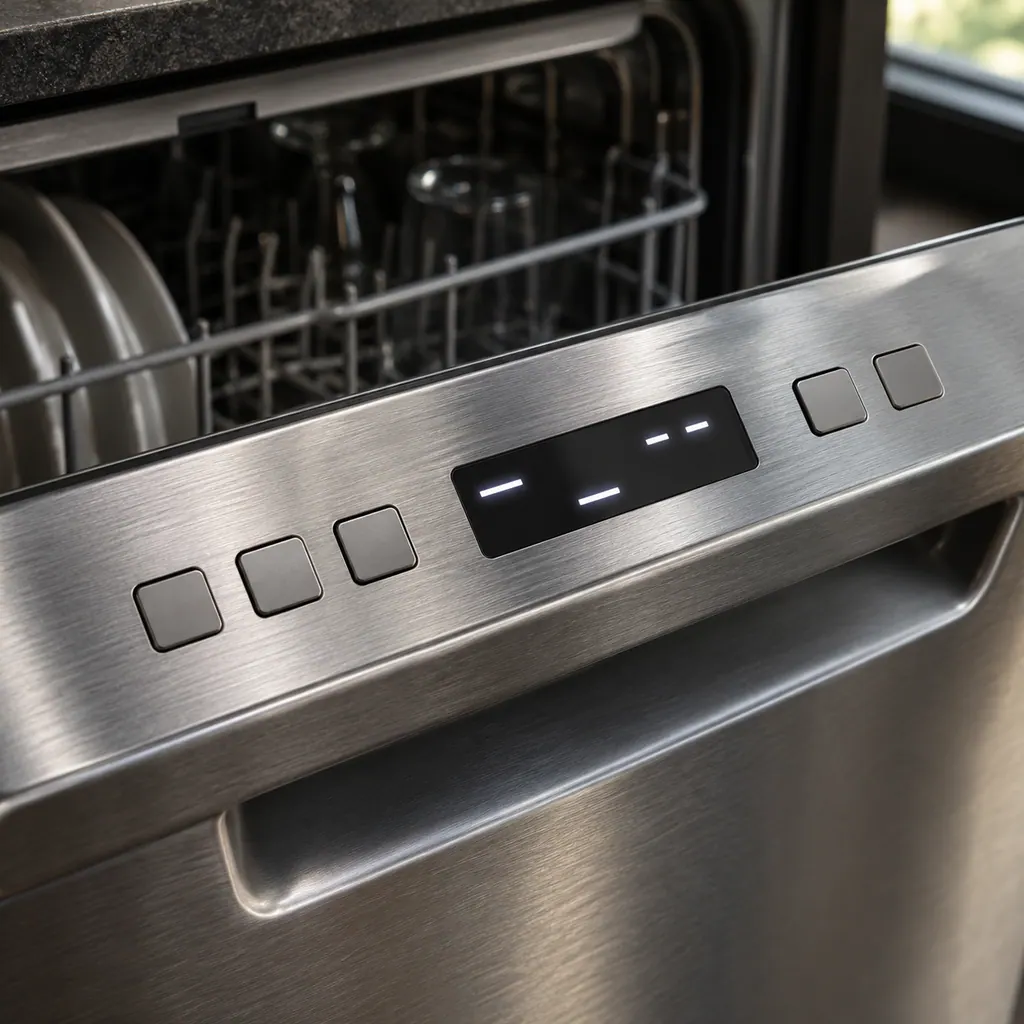
To change it later on the DBI786, open the door and press the On button. Scroll to Settings menu, confirm, and go to item 10, Water hardness. Pick the number and confirm. 1
Write the setting next to your hardness figure on the blank line in the manual. If you move house or your utility changes its supply, you'll know exactly where you started.
Once the softener is set, adjust your detergent and rinse aid for soft water. ASKO notes that too much detergent, rinse aid or salt makes the wash less effective. 1
How do I add salt to an ASKO dishwasher?#
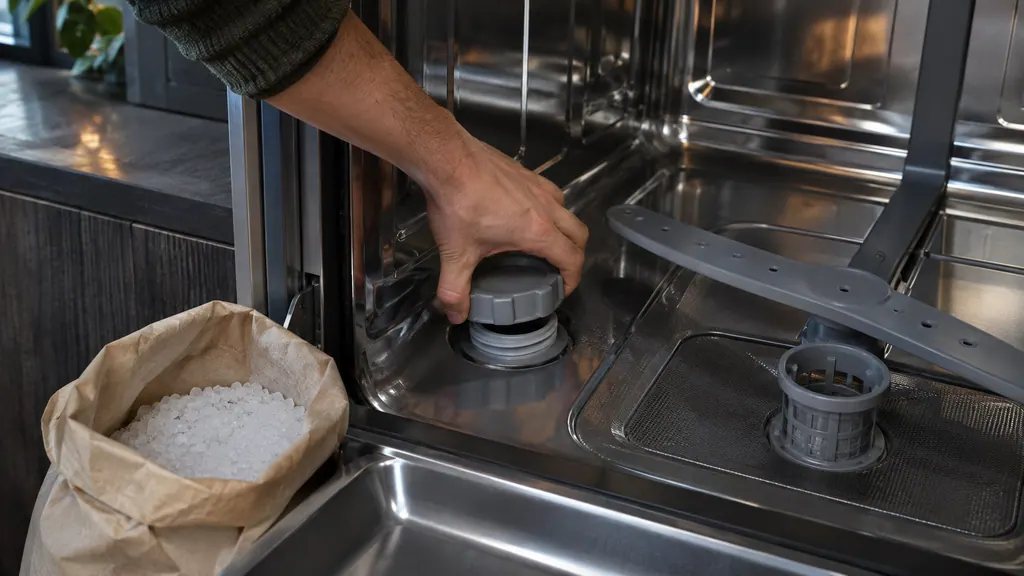
Unscrew the salt compartment lid, pour in special dishwasher salt through the funnel until it's full, wipe away spills and screw the cap back on. Then start a program straight away. The first fill also needs water. 1
- 1
- 2
- 3
- 4
When to refill#
You don't need a schedule. The DBI786 lights a salt symbol on the display when the compartment needs topping up. Refill whenever you see it. 1
ASKO also says never to run the dishwasher with an empty salt compartment if your water is harder than 5 °dH (5.9 gr/gal). 1
Why are my dishes still spotty with the softener on?#
Check four things: the salt compartment may be empty, the hardness setting may be wrong, the salt lid may not be tight, or an all-in-one detergent may be clashing with the TAB setting. Glass etching looks similar but can't be fixed. 1
Spots and film on dishes are covered in the DBI786 troubleshooting table. Work through it in order. 1
- Empty salt compartment. Fill it as described above. 1
- Wrong softener setting. Recheck your water report and the table. 1
- Salt leaking from the softener. Make sure the lid is turned clockwise all the way to its stop. 1
- TAB on with an all-in-one detergent that dries poorly. Switch detergents, or turn TAB off and use salt plus separate rinse aid. 1
- Rinse aid dose. Water marks call for more rinse aid; a sticky white or blue film calls for less. With very soft water, you can dilute rinse aid 50:50 with water. 1
ASKO's best results come from normal dishwasher detergent with separate rinse aid and salt. The TAB setting is for all-in-one products. It lowers the rinse-aid dose and changes how often the softener regenerates. 1
Cloudy crystal is a different story. Too much heat or detergent can etch it, and ASKO says that damage can't be repaired, only prevented. Wash crystal at a low temperature with a small amount of detergent. 1
Limescale already inside the machine needs its own clean. Our cleaning and descaling guide covers the citric-acid Self-cleaning run. If dishes still come out poorly, see dishwasher not cleaning.
When should I call a technician about the softener?#
Call if the salt lid won't tighten to its stop, salt seems to escape into the wash, or film returns despite the right setting and a full compartment. ASKO points a leaking softener to service. 1
The technician can inspect the softener and its connections, which you can't reach from the tub. You can book a visit or read about our dishwasher service.
The technician agrees the price with you before any work starts. The exact cost is confirmed after the on-site diagnostic. Repairs covered by the manufacturer's warranty go through ASKO itself. We give a warranty on our workmanship.
Sources#
- DBI786IXXLSSOF.U dishwasher user manualASKO / Gorenje Group · Document 879712en · pp. 7–9, 11, 20, 30–32, 34, 42–43
- DBI675 dishwasher operating instructionsASKO / Gorenje Group · Document 843099en · pp. 7, 16