On this page
- Hand dish soap must never go in an ASKO dishwasher; its foam stops the wash working. 12
- The detergent compartment must be dry when you fill it. 12
- Rinse aid dosage runs from 0 (off) to 5; the DBI786 starts at 4, the DBI675 at 5. 12
- Tablets are not recommended for programs shorter than 75 minutes. 12
- Turn on TAB only when your all-in-one detergent contains rinse aid. 1
What detergent should I use in my ASKO dishwasher?#
Dishwasher detergent, in the dose printed on its package for soft water. Powder, gel and tablets all work in the manual compartment. Never use hand dish soap: the ASKO manuals warn that its foam stops the dishwasher from working effectively. 12
This guide draws on two ASKO manuals: the user manual for the DBI786IXXLSSOF.U and the operating instructions for the earlier DBI675. They agree on the basics and differ in a few settings, which are named below. If your model is a different one, keep its own manual nearby for the button layout. 12
Why "soft water" doses? The DBI786 has a built-in water softener, and once it is set for your water, the manual says to dose detergent and rinse aid as you would for soft water. More is not better here. Both manuals warn that too much detergent makes the wash less effective. 12
Detergent also ages. The DBI786 troubleshooting table lists old detergent as a cause of dishes that are not clean and calls it a perishable product. Its advice is to avoid large packages, so buy a size you will use up. 1
Where does the detergent go?#
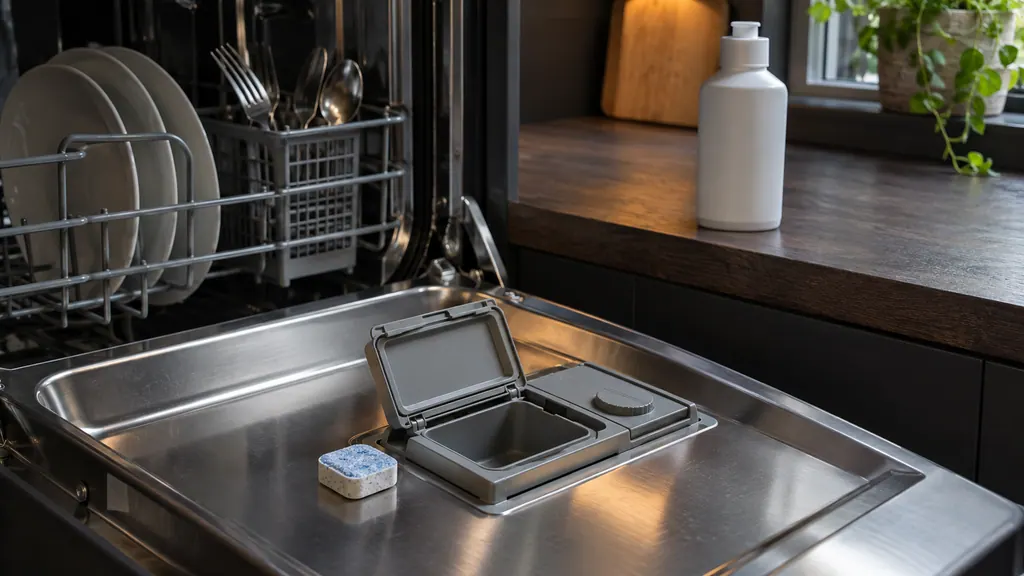
Into the manual detergent compartment. It has a main wash side and a smaller prewash side. The compartment must be dry when you fill it; damp powder can stick and stay behind after the wash. 12
- 1
- 2
- 3
- 4
Tablets and all-in-one detergents#
Tablets are convenient, but neither manual recommends them for short programs, under 75 minutes. Use powder or gel for quick washes. If a tablet makes the lid hard to close, the DBI675 manual says to break it in half, because a tight lid may not open and release the detergent. 12
Both manuals add a quiet note about all-in-one products. The best washing and drying results come from ordinary dishwasher detergent with separately dispensed rinse aid, plus salt on the DBI786. All-in-ones work, but read their directions carefully. 12
Auto dose on the DBI786#
The DBI786 can dose detergent for you. Turn on Auto dose in Settings, then fill its separate compartment with dishwasher detergent gel up to MAX. The dose depends on the program, and on Auto it also depends on how dirty the dishes are. 1
Only gel goes in that compartment: no powder, and never hand soap. The manual warns that some very thick gels don't suit it and belong in the manual compartment instead. When the gel runs low, a symbol appears, and you have one or two washes left. 1
Gel is milder than powder. For lipstick or tea and coffee stains, the manual suggests adding powder or an all-in-one with bleaching agent to the manual compartment while Auto dose stays on. Self-cleaning never takes gel from Auto dose; it uses what you put in the manual compartment. 1
Where do I add rinse aid, and what setting should I use?#
Rinse aid has its own compartment next to the detergent. Lift the lid, fill carefully to MAX, wipe up spills and close it firmly. The dosage setting runs from 0 (off) to 5 (high). The DBI786 starts at 4; the DBI675 starts at 5. 12
The ASKO manuals give rinse aid two jobs: it improves wash and drying times, and it helps glasses come out clear and spotless. The DBI786 shows a symbol on the display when the compartment needs topping up. 12
You change the dosage in the Settings menu. On the DBI786, open the door, press the power button, scroll to the Settings menu and confirm. Then choose Rinse aid and pick a number. Set it to 0 only if you don't use rinse aid at all. 1
Reading the results on your dishes#
Your dishes tell you whether the setting is right. The DBI786 manual ties each result to a fix, and most of them are adjustments you can make in a minute. 1
| What you see | Likely cause in the manual | What to do |
|---|---|---|
| Water marks | Too little rinse aid | Raise the rinse aid dosage 1 |
| Sticky white or blue film | Too much rinse aid | Lower the dosage; with very soft water, dilute rinse aid 50:50 with water 1 |
| Streaks | Too much rinse aid | Lower the dosage 1 |
| Heavy foaming | Too much rinse aid in very soft water | Lower the dosage or dilute 50:50 1 |
| Spots or film with TAB on | An all-in-one that dries poorly | Switch products, or turn TAB off and use salt and separate rinse aid 1 |
| White coating | Hard water | Check the water hardness setting and the salt 1 |
| Powder left in the compartment | Compartment was damp, or dishes blocked the lid | Fill it dry and keep the lid clear 1 |
| Etched crystal | Heat and too much detergent | Wash crystal on a low-temperature program with a small dose 1 |
Etching on crystal is the one result you cannot reverse. The manual is direct about it: the damage cannot be repaired, only prevented. That is why the Crystal program asks for a small amount of detergent. 1
Do I need dishwasher salt and the TAB setting?#
On the DBI786, you need salt if your water is harder than 5°dH (5.9 gr/gal). Set the water hardness in Settings and fill the salt compartment. Turn TAB on only when you use an all-in-one detergent that contains rinse aid. 1
Ask your water utility for your water hardness, then match it to the table in the manual. The softener settings run from 0 to 9. Setting 0 switches the softener off, and then you don't need salt. Above 50°dH, the manual recommends an external water softener. 1
TAB changes two things at once: it cuts the rinse aid dose and changes how often the softener regenerates. If you switch back to ordinary detergent, switch TAB off as well and refill the rinse aid. 1
Read more about the water softener and how its setting affects spotting.
When the dispenser is the problem#
Sometimes the product is fine and the dispenser isn't. If detergent is still in the compartment after a full program, check two things first: was the compartment dry when you filled it, and could the lid open? A plate or pan handle in the wrong spot is enough to hold it shut. 1
With Auto dose, the DBI786 has its own test. Press and hold the two buttons named in the troubleshooting table for five seconds. The symbol flashes and the status light turns red; then look whether gel has come out. Lift out the gel compartment, check its dispensing hole, rinse it with hot water and refit it. Never run the machine without it. 1
Our page on a detergent dispenser that is not opening walks through those checks. If dishes are dirty despite the right dose, the page on dishes not getting clean covers filters, spray arms and loading.
Our dishwasher service covers ASKO models like these. The technician agrees the price with you before any work starts. The exact cost is confirmed after the on-site diagnostic. Repairs covered by the manufacturer's warranty go through ASKO itself. We give a warranty on our workmanship. Book a visit whenever you are ready.
Sources#
- DBI786IXXLSSOF.U dishwasher user manualASKO / Gorenje Group · Document 879712en · pp. 7–11, 20, 22, 30–32, 34, 42–44
- DBI675 dishwasher operating instructionsASKO / Gorenje Group · Document 843099en · pp. 7–8, 16