On this page
- If a magnet sticks firmly to the base, the pan is suitable for induction. 1
- Copper, aluminum, porcelain, earthenware and plastic don't work. 1
- Each zone needs a minimum pan size; too small a pan won't heat. 1
- Boost runs for up to 10 minutes, then drops to setting 12. 1
- Remove sugary spills right away, even while the glass is hot. 1
What cookware works on an ASKO induction cooktop?#
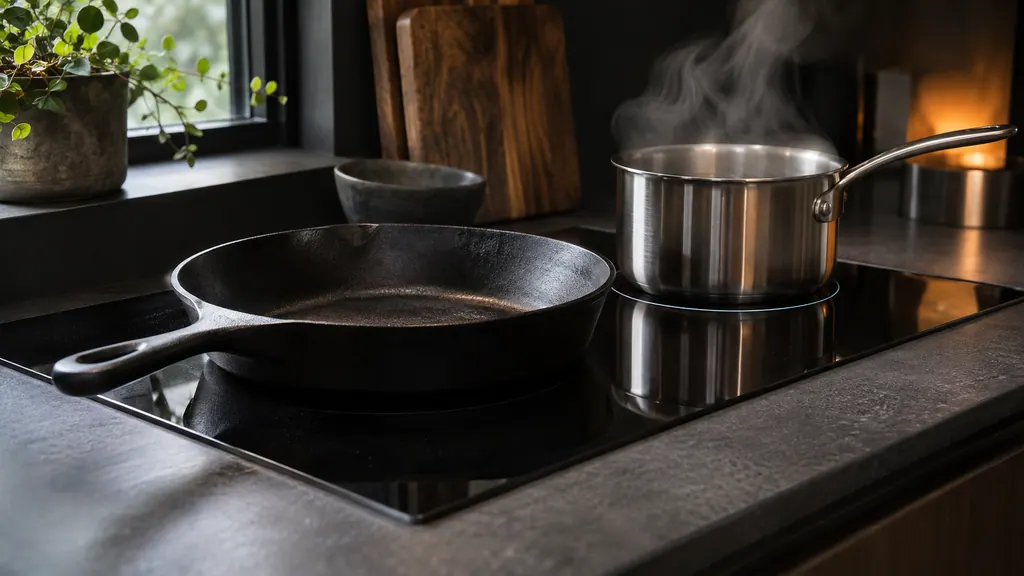
Magnetic pans with a flat base at least 2.25 mm (about 3/32 in) thick. Hold a magnet to the bottom of the pan: the ASKO manual says the pan is suitable if the base is attracted firmly enough. 1
The facts here come from the ASKO operating instructions for the HI5320F, HI5632F, HI5642F, HI5643F, HI5842F, HI5952F and HI5954F induction cooktops. That manual cites Australian and European rules rather than US ones, and it says some functions it describes may not be on every model. Your cooktop's own manual is the final word on its zones and controls. 1
Induction works differently from a radiant or gas burner. The heat is made in the pan itself, so the glass gets no hotter than the pan, and the zone cools quickly once the pan comes off. That is why the pan's material matters so much: a pan that doesn't react to the magnetic field simply won't heat. 1
One rule surprises people. The manual says pans already used on a gas hob are no longer suitable for induction cooking. If you are moving from gas, test those pans before you rely on them. 1
Which pans won't work?#
Copper, aluminum, porcelain, earthenware and plastic are on the manual's unsuitable list. Plain stainless steel is listed as unsuitable too, while special stainless steel pans made for induction are fine. The magnet test settles it for any pan you aren't sure about. 1
| Suitable | Not suitable |
|---|---|
| Special stainless steel pans | Earthenware |
| Class Induction pans | Stainless steel (not made for induction) |
| Solid enameled pans | Porcelain |
| Enameled cast-iron pans | Copper |
| Plastic | |
| Aluminum |
Source: Pans for induction cooking. 1
Watch the base, not just the material#
A good material in a bad shape is still a problem. The manual warns never to use pans with a misshapen base: a hollow or rounded bottom can stop the overheating protection from working properly. In the worst case the glass top can crack and the pan base can melt. 1
Enameled sheet-steel pans need a gentle start. The manual says the enamel can chip if you switch on a high setting while the pan is dry, and the base can warp if it overheats. Heat these pans slowly. 1
How big does the pan need to be?#
As big as the zone, ideally. The ASKO manual says you get the best results with a pan the same diameter as the zone, and a pan that is too small will not make the zone work at all. Each zone has a minimum base size. 1
| Cooking zone | Minimum pan base |
|---|---|
| 180 mm (about 7 in) round | 110 mm (about 4.3 in) |
| 210 mm (about 8.3 in) round | 145 mm (about 5.7 in) |
| 190 × 210 mm Bridge zone | 145 mm (about 5.7 in) |
| 260 mm (about 10.2 in) round | 145 mm (about 5.7 in) |
Source: Pans for induction cooking. Inch values are rounded conversions. 1
A smaller pan on a big zone still heats, but more slowly. The manual explains that the zone adjusts its power to the pan's diameter, so the power is lower and it takes longer to boil. On models with Bridge zones, a large pan can link the front and rear zones into one. 1
What to expect the first time you cook#
A few things feel strange at first and are normal. The manual lists a faint "new smell" for the first few uses, characters on the display when power is first connected, a fan that runs on after cooking and a soft ticking. Ventilate the kitchen and carry on. 1
Speed is the other surprise. Induction brings food to a boil very fast, especially at high settings, so the manual advises not to leave pans unattended. Handles stay cool, and keeping a lid on saves energy. 1
- 1
- 2
- 3
- 4
If no zone is active for 60 seconds, the cooktop powers itself off. The residual heat indicator stays lit on any zone that is still hot, even after power is off, so don't touch those zones until it goes out. 1
Which level for which job?#
The manual gives a rough guide and says it depends on the pan and how much is in it. Settings 1–5 are for simmering, stewing, poaching and melting chocolate or cheese. Settings 6–9 finish large quantities. Settings 10–11 suit thick pancakes, bacon and breaded fish, and 12 is for searing and omelets. 1
Boost is for bringing liquid to a boil fast, heating oil or wok cooking. It runs for up to 10 minutes and then drops to setting 12. The electronics can also end it early to prevent overheating. Some models add a PLUS menu with keep-warm, frying and grilling functions, which work best with stainless steel sandwich-base pans; the manual doesn't recommend cast iron or steel for them. 1
Keeping the glass clean and scratch-free#
Wait for the glass to cool, then wipe it after each use. Remove sugar and sugary spills at once with a scraper, even while the glass is hot, because sugar can damage it. Never use abrasives, steel wool or a steam cleaner. 1
The manual warns that grains of sand, salt or sugar under a pan can leave scratches that won't come out. Wipe the pan bottom and the glass before you cook, and lift pans to move them instead of sliding. 1
For stubborn marks, use a non-abrasive cleaner made for glass-ceramic. If you use a scraper, hold it at 45° to 60° and press gently; don't dig in with the tip. A ring the shape of the pan that won't wipe off can come from a dirty pan bottom, so clean the pan too. Turn on the child lock before you clean so you can't switch on a zone by accident. 1
Why is the zone flashing when I put a pan on it?#
The manual's answer is the pan. A zone that flashes after you switch it on points to cookware that isn't suitable for induction, or a pan less than 12 cm (about 4.7 in) across. Try a pan that passes the magnet test and fits the zone. 1
When several zones run at once, a flashing level can mean something else. The cooktop shares its power between zones, and when the total gets too high, it lowers one zone to the highest level available and flashes that zone's control. That's the power limiter at work. 1
If a zone stops by itself with the residual heat symbol on, the manual says it overheated; let it cool and carry on. For a zone that stays cold with a good pan, see our page on a cooktop zone not heating. For codes on the display, see cooktop error on display.
Our cooktop service covers ASKO induction models. The technician agrees the price with you before any work starts. The exact cost is confirmed after the on-site diagnostic. Repairs covered by the manufacturer's warranty go through ASKO itself. We give a warranty on our workmanship. You can book a visit when you're ready.
Sources#
- Induction hob HI5320F, HI5632F, HI5642F, HI5643F, HI5842F, HI5952F, HI5954F operating instructionsASKO / Gorenje Group · Document 941125en (HTML manual) · Important safety instructions (Induction use, Safe use, Cooking time limiter); Use (Induction cooking, Pans for induction cooking, Induction sounds, Cooking levels); Operation (Standard cooking, Boost, Cooking with the PLUS menu); Maintenance; Troubleshooting